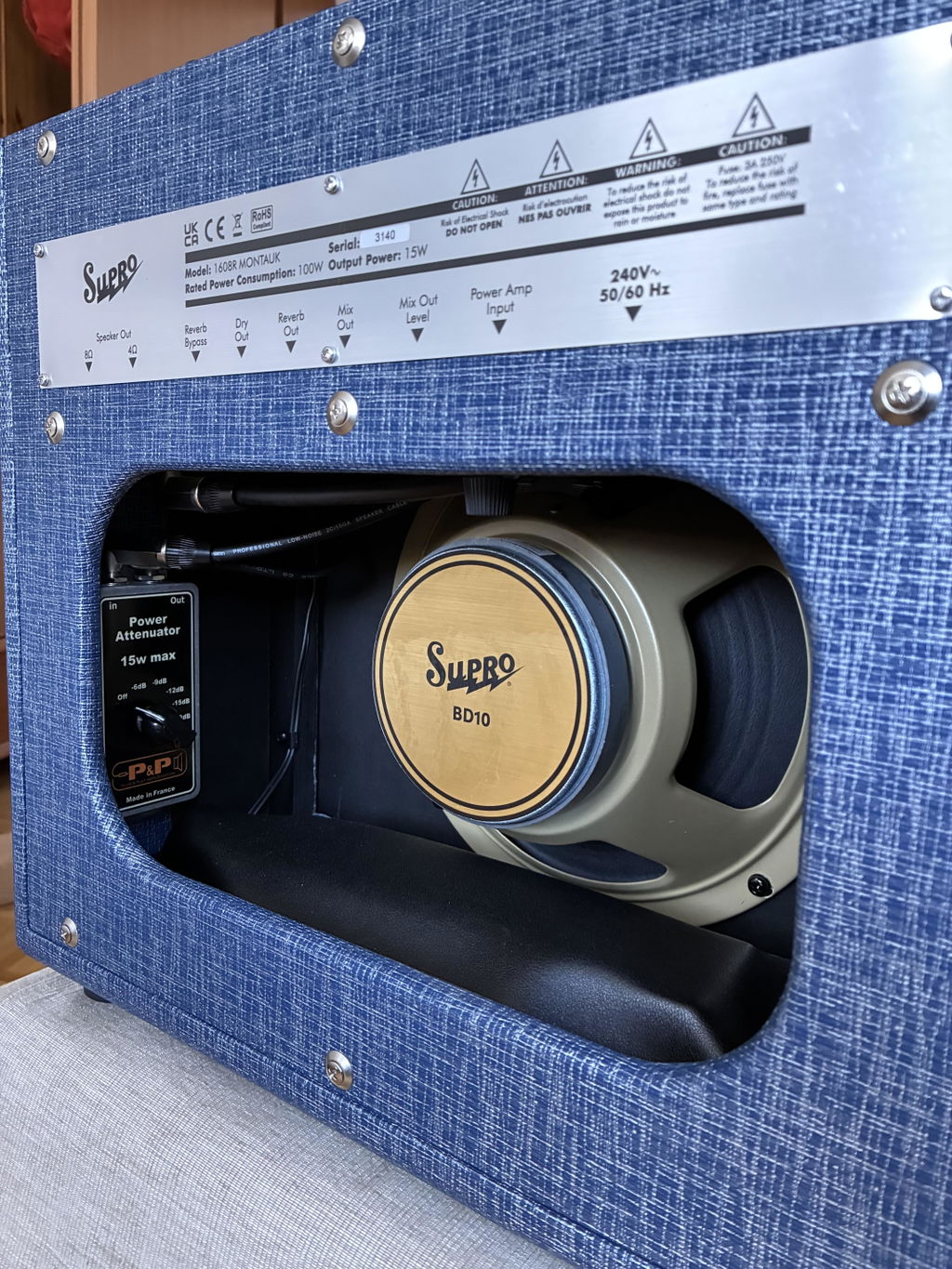
Get the best from your tube amp at a controlled volume!
This power attenuator is placed between your amplifier and its speaker.
It allows you to increase the volume of your amp, and therefore get the best from your tubes, while controlling the output level thanks to the 5 available positions.
There is no loss of treble, the sound remains transparent, even at -18dB.
In all situations...
InClass A , with a Marshall Class 5 type amp, you will thus obtain a superb overdrive at the volume you want.
InClass AB , with a Vox AC15 type amp, or even a Fender Blues Junior, you will be able to enjoy the warm and round sound of the tubes in your amp at the desired volume.
The attenuator transforms power into heat, which explains the presence of vents on the sides of the casing. It's essentially a "watt sponge".Note: three models available: 4 ohms, 8 ohms and 16 ohms.
Furthermore, this attenuator is only suitable for amplifiers with a maximum power output of 15W. For higher power outputs, please refer to the more powerful models.
Connection cables are available in the shop.
It does not require a power supply.
As with most of our products, it is hand-wired point-to-point (no printed circuit board) and has a 2-year parts and labor warranty.
FAQ
How do I connect my Power Attenuator 15 to my amp?
The PA15, like other attenuators, connects between the amplifier and its speaker. If you have a two-piece amp (head + cabinet), use standard speaker cables (see our shop). If you have a combo amp, use the jack/male and female spade connector adapters available in our shop.
Can I plug it into the external speaker output on my combo amp?
Yes, if the speaker is disconnected. You will then use a speaker cable between the amp and the attenuator, and a jack to female spade adapter to connect the attenuator to the speaker.
Can I install the attenuator inside my combo amp?
In theory, the attenuator should be installed in a well-ventilated area. It's up to you to judge whether the inside of your combo amp is sufficiently ventilated. This will usually be the case with open-back combos.
What effect does the attenuator have on sound quality?
The circuit used is as transparent as possible; normally, it doesn't "dirty" the sound. In some cases, an overdrive effect is noticeable when pushing the tubes (Class A amps), or an increase in dynamics brings out a bit more bass. In any case, if there's any modification to the sound, it's to achieve a better result.
Why buy a power attenuator?
Two possibilities: Either to play at a lower volume while still benefiting from the dynamics of the tubes, or to work on the voicing of the amp, that is to say, to obtain a sound colored by the tubes at a relatively high volume (especially in class A).
Do my lamps wear out faster when I use a dimmer switch?
It all depends on how you use your attenuator: if you push your amp to its limit, the tubes will wear out faster. But most amps perform best between a quarter and half of their volume control's range. There's no need to push it any further. Under these conditions, the attenuator has little impact on tube lifespan.
Does the Power Attenuator 15 need to be powered?
No, there is no need to power the power attenuator.
Can I use instrument jacks to connect the attenuator to my amp?
No, because the diameter of the wires in these types of cables is far too small and therefore unsuitable. Use only speaker cable. You can find it at the P&P store .
Does the Power Attenuator get hot?
The power is converted into heat, so yes, it does get a little warm. However, it will never become burning hot. Particular attention was paid to heat dissipation during its design, as evidenced by the ventilation vents on each side of the case.
What are the risks of connecting the Power Attenuator 15 to a 50w amplifier?
You risk destroying the amplifier's attenuator and output transformer. Never attempt this.
How long is your equipment guaranteed for? What does this guarantee cover?
Plug & Play Amplification products are guaranteed for a period of 2 years, parts and labor.
A fine tool to get crunchy sound of my 5 watt 8'' Champ. Only 4 stars, because in my little practice room, it would need even more attenuation to play as well guitar as amp on maximum power .
S
Steffen Beckedorf
Ich habe bereits mehrere Attenuator von P&P Amplifications eingesetzt. Die einbaubaren sind perfekt für kleine Röhrencombos wie beispielsweise der Tweed Deluxe. Ich werde sicher noch mehr davon kaufen und einsetzen!
Bisher keine Probleme mit dem Gerät selbst oder der Lieferung etc.